Who is allowed to define what happened?
When two people describe the same experience differently, whose version gets treated as fact?
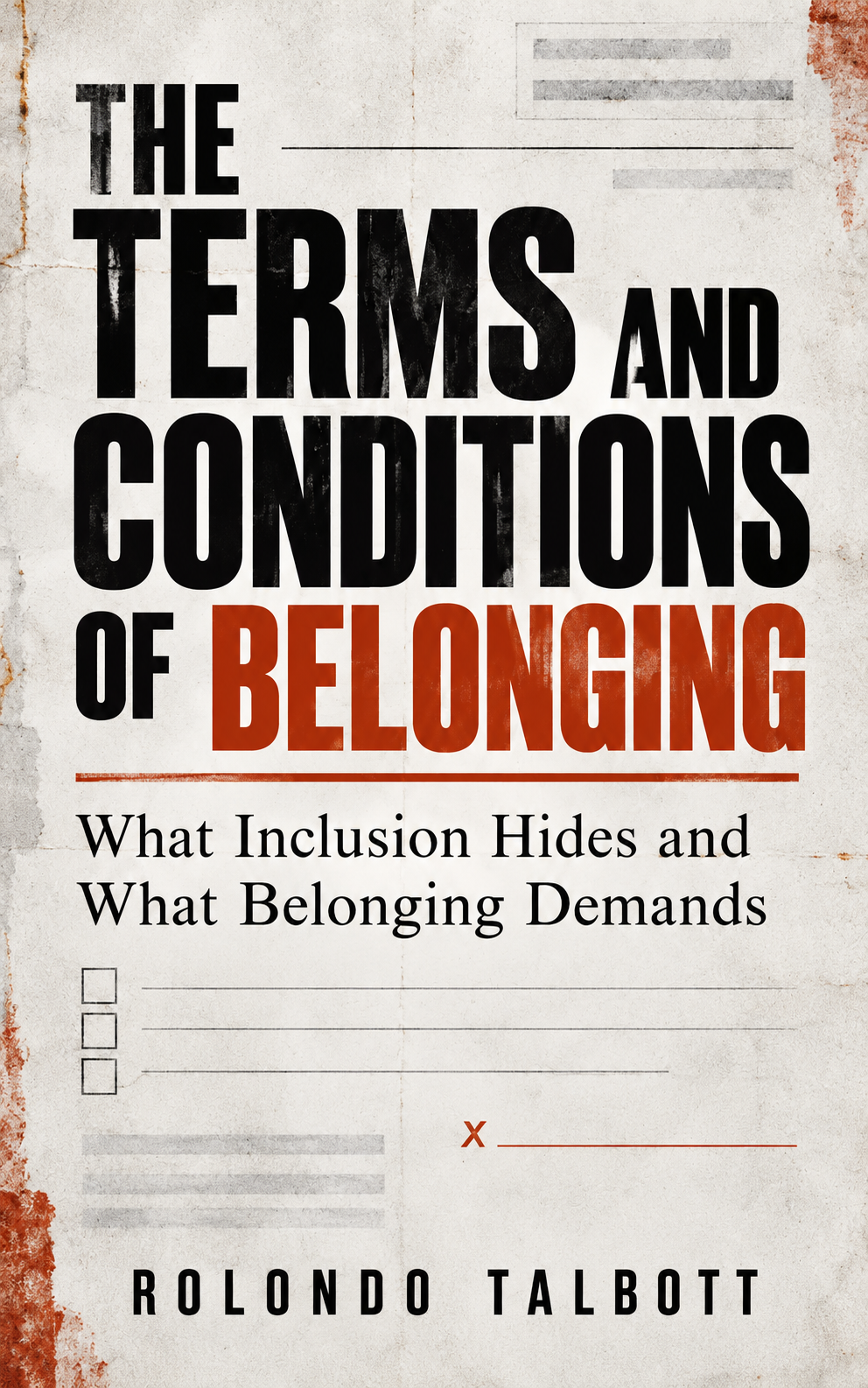
What Inclusion Hides and What Belonging Demands
What if belonging is not simply something institutions offer, but something people are required to earn by becoming easier to interpret, manage, and trust?
I wrote this book after years of noticing the same pattern in different rooms: people could be included and still have very little say in how they were understood. The book follows that tension through credibility, professionalism, access, disclosure, harm, repair, and the quiet work of making yourself easier for a system to accept.
I keep returning to a simple tension: being invited in is not the same as having power over the terms of participation. A workplace can offer accommodations and still make people prove they deserve them. A leader can say “bring your whole self” and still reward only the parts that feel familiar. The book stays with those contradictions and asks what would have to change for belonging to require less self-erasure.
When two people describe the same experience differently, whose version gets treated as fact?
At what point does adapting to a room stop being flexibility and start becoming a requirement to disappear?
What good is access if someone else still controls when, how, and on what terms you receive it?
Why can a person be formally protected and still be treated as less credible, capable, or trustworthy?
If the invitation is real but the rules remain untouched, how much has actually changed?
What would we build differently if we expected human variation from the beginning instead of treating it as an exception?
What happens when a person explains their own experience, someone with more authority reinterprets it, and that reinterpretation becomes more credible than the person who lived it.
Neurodivergent leaders can be seen, but only in pieces. The parts that do not match the familiar leadership template are often the first to be filtered out.
A way I think about harm when the same act lands differently depending on power, proximity, repetition, and whether repair is actually possible.
The distance between being formally protected and actually being treated as credible, capable, and able to make decisions about your own life.
Start from the assumption that people vary. Build access in before anyone has to disclose, explain, or justify a need.
A way of asking a harder question than “How do we include people in this system?”: what would the system look like if dignity, agency, participation, and human variation helped shape it from the start?
I wrote it for people who lead, design, teach, advocate, work inside systems, or have had to spend too much energy making themselves legible to one. You do not need a DEI title or a background in neurodiversity to enter the conversation.
If your team, employee group, class, or book club wants to use the book as a starting point for a conversation, I am available for talks and facilitated discussions.
Start a conversation →What Inclusion Hides and What Belonging Demands